COMMON

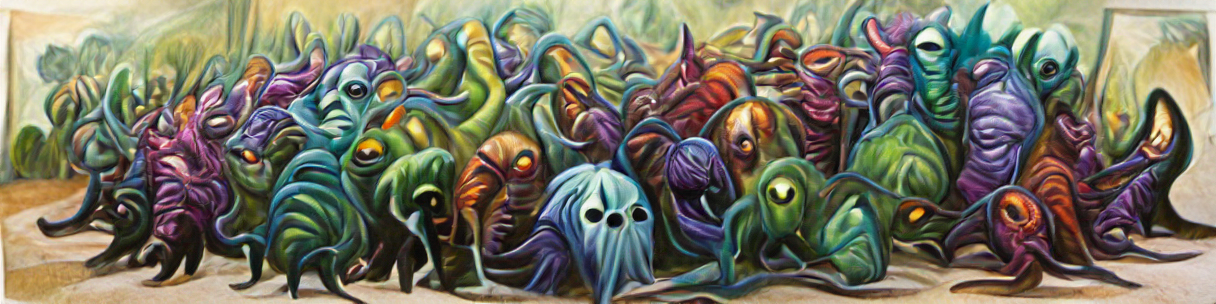
#008 Zoupir

Zoupir are small, insect-like pigs that travel underground, in packs. They feed primarily off dirt and roots, sucking nutrients from crops and vegetation in the area. They are an invisible pest, but farmers with a little know-how know how to spot signs of their presence.

Release Date January 04, 2022
Sign up for a free account to claim this creature as your own.

Discover other creatures

Explore an endless universe of ficticious life on NovelGens.

UNCOMMON

#041 Weiffalo

Weiffalo produce a seasonal wool that is as light as clouds. When Weiffalo have thick, natural coats, they love to ride strong gusts of wind around open fields, often bumping into each other both in the air and upon landing. Weiffalo also love to ...

RARE

#118 Herenella

Herenellas are seahorse-like creatures whose bodies form non-euclidean shapes. They feed on ambient temperature differences deep in the ocean. These creatures are very intelligent and will often be found in tight clusters of dozens to hundreds. He...

UNIQUE

#127 Joprao

The joprao is a flying, amphibious creature which grows to be about four meters in length. It makes its nest in the long grasses of the savanna, where it lays and incubates its eggs. In order to attract mates and protect its territory, the joprao ...

RARE

#196 Fa'gu'leyth

The monstrous fa'gu'leyth is an extradimensional parasite from an unknown source. Initial tests indicate the fa'gu'leyth is capable of infecting native plantlife (especially moss) with a hivemind-like syndrome. It has been determined that the fa'g...

RARE

#322 Ungarmel

When a creature is near, an ungarmel on the prowl will curl up in a ball and hover above the ground, doing its best to blend in with the environment in order to catch its prey unaware. When the time is right, the ungarmel will attack by releasing ...

COMMON

#349 Flayansk

The flayansk originates in the far north, in the freezing highlands of Cotsk. Flayansk vary wildly in size throughout their life, growing quickly from the size of rodents to the size of large boulders, then eventually shrinking back to microscopic...