RARE

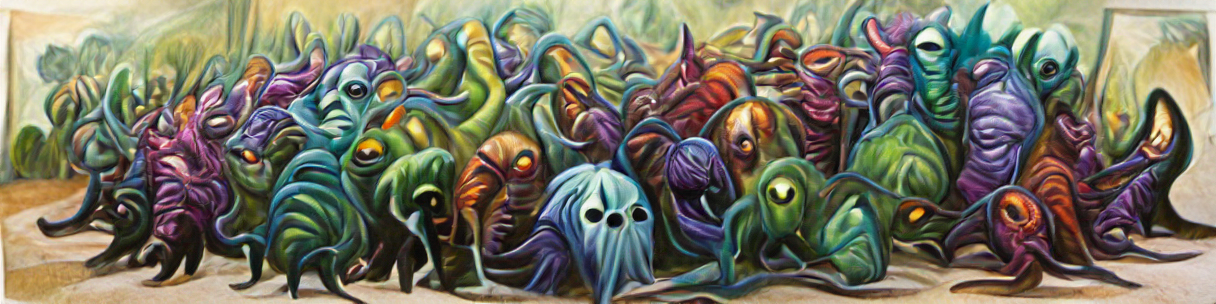
#258 Tarodo

Tarodos are dangerous cave-dwelling creatures. Their long tentacles are able to find and grasp prey from far away to drag it into their subterranean lairs. Tarodos usually hunt alone from the safety of their lair, but sometimes a few tarodos will group up to work together and overwhelm larger prey. While their sticky, venomous tentacles are a threat to most animals, some fish are able to swim up the tentacles and into the tarodo's mouth to retrieve half-digested fish scraps, as the tarodo's hooked tentacles struggle to grab small things that are moving quickly up the tentacle.

Release Date September 11, 2022
Sign up for a free account to claim this creature as your own.

by NovelGens

Discover other creatures

Explore an endless universe of ficticious life on NovelGens.

COMMON

#017 Dust Angel

The dust angel is a common critter in arable desert areas. Nutrients from their saliva propagates through plants into the soil, improving yield for all plants in the vicinity. They're extremely rare and expensive, but the richest farming organizat...

COMMON

#025 Baibi

This small monkey navigates long distances by utilizing the bug-like wings on its back and can commonly be seen flying from forest to forest during the day. Their silhouette in flight mimicks those of birds, but birdwatchers with an eye for what t...

RARE

#044 Zweifhlaightte

Zweifhlaughttes are colossal slugs from a time long before humans that have an interesting physiological compartmentalization not present in other species on the planet. The majority of the body remains buried underground in self-dug caves, while ...

RARE

#108 Nulstiver

Nulstivers are large, werecreatures that are native to ancient tundra wastelands. They are generally quite docile and tend to move extremely slowly unless provoked. Despite being quite fearsome in appearance, they are typically quite friendly, oft...

UNCOMMON

#169 Havough

The large havough bird towers above trees, hills, and mountains with its imposing stature. Although havoughs typically fly into outer space to hunt for food, they often prefer to relax for weeks at a time in our atmosphere between meals. Although ...

UNCOMMON

#284 Senjfisk

Senjfisk use thousands of microscopic limbs to move sand around them, enabling them to effectively swim through sand and loose dirt. These nocturnal carnivores also undergo a biological stasis while sleeping, which completely stops all but their m...